Hide $1 and placeholder prices on Facebook Marketplace
Quick answer
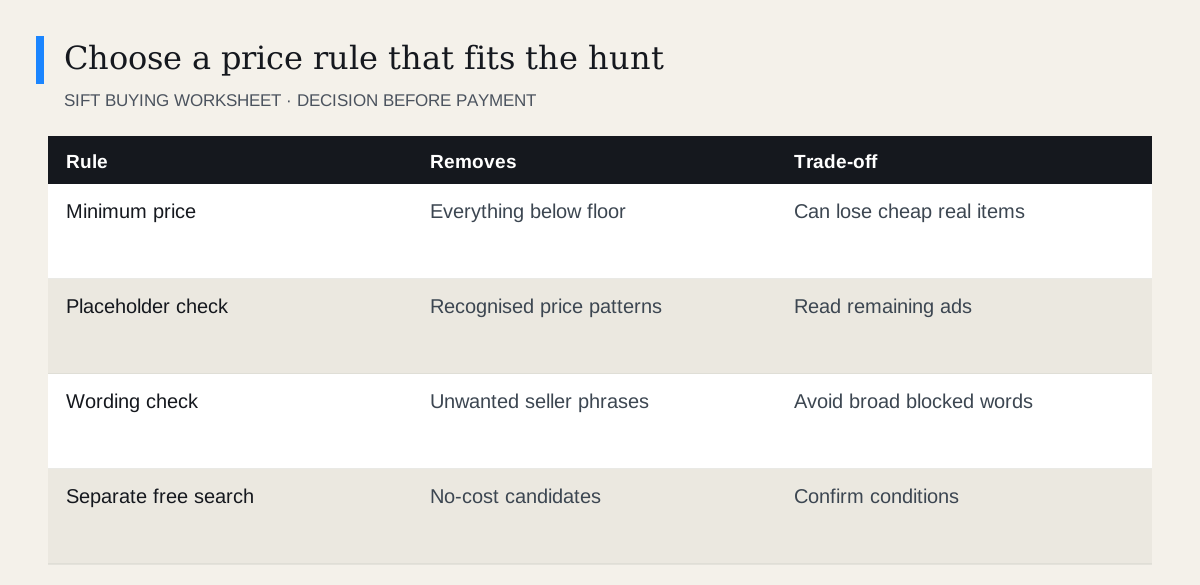
Set a realistic minimum price in Facebook Marketplace to remove many $1 listings, then inspect the remaining prices in context. A price floor also hides genuine cheap items and will not catch every placeholder. On a computer, Sift can hide placeholder prices and unwanted wording, giving you a more targeted way to reduce price bait.
 Enlarge diagram
Why do sellers use $1, $123 or $1234?
The visible price may not describe the item you want. A seller could list several items with different prices, use a nominal amount while asking buyers for offers, advertise an instalment or want people to request a quote. Some small items really do cost one dollar.
Before assuming intent, read what the price refers to. A box of hardware sold per piece is different from a sofa advertised at $1 with a much larger amount in the description. Both are unhelpful if your search is meant to compare complete sofas under a fixed budget.
What can you do with Facebook’s native filters?
Use the price range shown for your search and category. Start with a minimum that makes sense for the item, rather than an arbitrary high number.
- Choose a specific item and category. A price floor for a dining set will be too high for individual plates.
- Apply a modest minimum. Remove the obvious nominal prices without discarding every inexpensive listing.
- Keep your maximum realistic. It should reflect the item price you can afford before transport and other costs.
- Read a sample of the remaining ads. Check whether prices refer to a full item, deposit, monthly amount or individual piece.
- Review the trade-off. If genuine bargains disappeared, lower the floor and inspect more carefully.
The exact filter controls differ by category and interface. Facebook’s original Marketplace overview describes filtering by price and location; use the controls currently available in your view.
Why is raising the minimum sometimes the wrong fix?
Suppose a search contains a genuine $25 side table, a $1 sofa placeholder and a $123 “contact for price” sofa. Raising the minimum to $150 removes all three, including the table you could actually buy. It also prevents you from discovering another seller’s real $100 sofa.
Those figures are illustrative. The principle is that a broad price rule cannot tell why an amount was entered. Use a separate search for low-cost accessories, another for full furniture pieces, and a dedicated search for free items when that is your goal.
How should you handle “message for price”?
Do not spend a long exchange trying to extract basic terms. Send one specific question: “What is the total price for the complete item shown, including the pictured stand?” If the answer is clear and fits your budget, compare it normally. If the seller will not state the price, remove it from your shortlist.
| Wording | Ask |
|---|---|
| From $50 | Which version costs that amount? |
| $20 each | How many units are included in the photo? |
| Deposit only | What is the complete price and payment arrangement? |
| Trade value | Is cash accepted, and at what price? |
| Free with purchase | What purchase is required? |
Avoid treating ordinary words such as “offer” as automatic exclusions. You could remove a legitimate seller who wrote “reasonable offers welcome.”
Where do Sift’s filters help?
Sift can hide placeholder prices and listings containing wording you choose while browsing on a computer. That is more targeted than simply raising every search’s price floor. Start with the problem phrases you are repeatedly seeing, then review hidden results to check that useful listings are not being excluded.
Use the word filter guide for narrowing the language, and keep a separate setup for free-item searches. A filter is a way to control what you review; it is not proof that the remaining asking prices are fair.
Once the cards show plausible prices, compare total buying cost. A clear $200 listing can still cost more overall than a $240 one that includes the missing accessory and a manageable pickup.
Questions people ask
Does a $1 price always mean a scam?
No. It can represent one small item, a starting price, an auction-like request or a placeholder. Read the description and ask for the actual item price.
Will a minimum price hide every placeholder?
No. Higher placeholders such as $123 can remain. A high floor can also remove real bargains.
Can I still search for genuinely free items?
Yes. Treat looking for free items as a separate search, and confirm whether the entire item is free or a paid purchase is required.
Sources
- 01Meta Introducing Marketplace
- 02Meta Tips for Shopping Safely