Refurbished, open-box or used: compare the evidence
Quick answer
Treat refurbished and open-box as claims to investigate. Identify who prepared the item, what was tested or replaced, what remains imperfect, and which written return and warranty terms apply to you. Compare the same exact model and complete kit before deciding whether a higher price buys something useful.
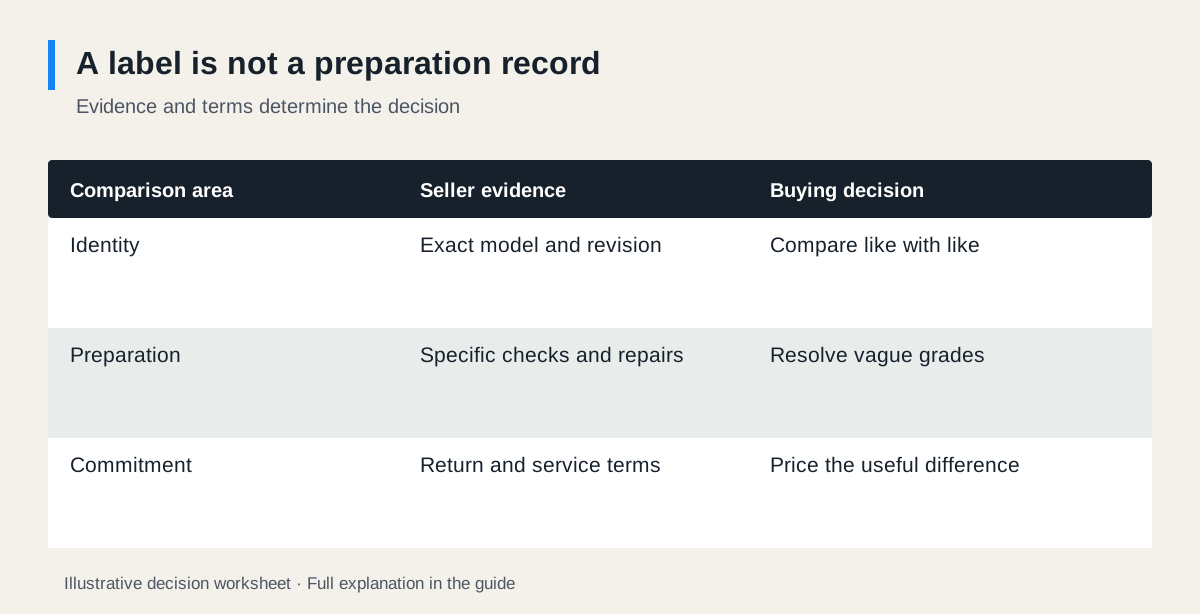 Enlarge diagram
What does each label actually establish?
A condition label helps you ask the next question; it does not replace the answer. “Open-box” might mean a returned item, display stock or simply damaged packaging. “Refurbished” might describe manufacturer work, a reseller’s process or an unexplained listing title. “Used” says little about how carefully an item has been maintained.
Ask the seller to describe this unit rather than a grade in general. Which functions were checked? Was anything repaired or replaced? Are any defects excluded from the grade? Does the pictured item match the one supplied? Is the preparation record tied to the model or serial number?
A named manufacturer programme can provide a concrete comparison. Apple’s US Certified Refurbished page describes functional testing, cleaning and inspection, genuine replacement parts where needed, included accessories and a one-year limited warranty. Those commitments belong to that programme. They do not establish what an unrelated seller means by “Apple refurbished,” nor make every product’s battery treatment identical.
Compare one model in three formats
This is a hypothetical example for the same monitor model and revision. Prices and seller terms are invented planning inputs, not actual offers. All candidates still need their identity and condition checked.
| Evidence | Private used, $130 | Retail open-box, $175 | Reseller refurbished, $195 |
|---|---|---|---|
| Unit identity | Label photograph matches | Exact unit reserved for inspection | Model known; revision initially missing |
| Demonstration | Buyer’s needed input can be shown | In-store demonstration allowed | Seller provides a test checklist |
| Included parts | Stand and power supply; no signal cable | Stand, supply and required cable | Supply and cable; stand missing |
| Known condition | Small case mark | Open packaging; case mark disclosed | Replaced input board claimed |
| Additional cash | $15 cable + $10 collection | $10 collection | $35 compatible stand + $20 delivery |
| Acquisition total | $155 | $185 | $250 |
| Written voluntary terms | No return agreed | Seven-day return in this scenario | Thirty-day repair service in this scenario |
The private item is cheapest to acquire. The open-box premium is $30 over that total, not $45. Whether the premium is worthwhile depends on what the written seven-day policy actually permits and whether it gives time for your necessary tests. The refurbished option is not yet comparable: the revision and replacement stand compatibility must be confirmed.
Do not automatically treat the longest advertised coverage as best. A repair-only promise with buyer-paid shipping can be less useful for your deadline than a shorter return option. A promise from a business that cannot identify the covered item is not resolved by the word “warranty.”
Make the preparation claim specific
For the refurbished monitor, ask for the scope of the board replacement and testing, who did the work and whether the service promise covers that work. You do not need the previous owner’s personal information. You need evidence relevant to the unit and the functions you will use.
For the open-box option, ask whether the return was because of a fault, whether the seller checked the actual unit and whether it contains every listed accessory. An intact box is not proof of completeness. A missing proprietary supply can matter more than a scratched carton.
For the private used option, agree a normal-use demonstration with your intended device and required input. The monitor buying guide covers product checks. A short demonstration can establish an observed function; it cannot establish remaining life.
Read the commitments separately
Create three lines in your notes: return policy, warranty or service promise, and applicable consumer rights. A seller’s voluntary return policy is not the same as a manufacturer warranty. Neither replaces rights that apply to the transaction under local law.
The FTC’s marketplace guidance recommends checking written seller terms and the protection offered by the marketplace. The fact that the listing was found on a familiar platform does not establish that a private payment receives the same protection as an eligible checkout purchase.
Use the returns guide to establish the deadline, permitted reason, refund method, packaging requirements and who pays return transport. Use the manuals and warranties guide to check a claimed manufacturer benefit against the actual item and buyer eligibility.
When does the label change your choice?
In the example, the buyer needs a monitor for work on Monday. They can inspect the private item on Saturday, but have no alternate display if it fails later. The open-box item is available Saturday and its written return terms cover the planned home compatibility test. That may justify $30 more if return transport and replacement timing are manageable.
The refurbished listing stays pending until the revision, stand and repair terms are documented. If the seller cannot resolve them, pass. It is not necessary to prove that the listing is dishonest; it simply has not met the buyer’s requirements.
If all three items are equally suitable and the buyer can accept the private option’s condition and terms, the lower-cost option may be reasonable. If the supposed upgrade adds only packaging or a vague grade, the premium has not yet bought a useful commitment.
Put the evidence into your shortlist
In the listing comparison tool, enter item price, collection or delivery, and repairs or missing parts. In condition notes, record the demonstrated input, included stand and unresolved revision. The tool totals acquisition costs; it does not rank warranties or certify refurbishment.
Before paying, save the item-specific description and the terms that made the choice worthwhile. If the seller changes the unit, accessories or policy, repeat the comparison. You are buying a particular item under particular terms, not the condition label in isolation.