Used cassette decks: transport, playback and service evidence
Quick answer
Identify the exact deck and required playback or recording functions. With the seller, use an expendable known-good tape to observe normal transport, both channels and any recording function you need. Stop if tape handling is abnormal. A clean faceplate or a brief moving counter does not establish transport condition, correct speed or completed servicing.
Decide whether you want playback, recording or restoration
A deck for playing a few family tapes is a different purchase from a machine for regular recording or a deliberate restoration project. Record the required tape types, playback directions, recording functions and outputs, then check them in the exact manual. A dual-well deck does not necessarily offer the same features in both wells.
Ask for the model, service history and the work actually performed. “Serviced” could mean a documented transport repair or only exterior cleaning. Request the date, technician or business record and replaced parts where available. Do not treat a seller’s belt claim as proof of correct alignment, speed or every remaining mechanism.
The TASCAM 202MKVII manual shows separate controls and functions for tape transport, recording and outputs. Use the corresponding manual for your candidate. Do not copy a procedure from a different deck, particularly for maintenance or adjustment.
Bring a tape you can afford to lose
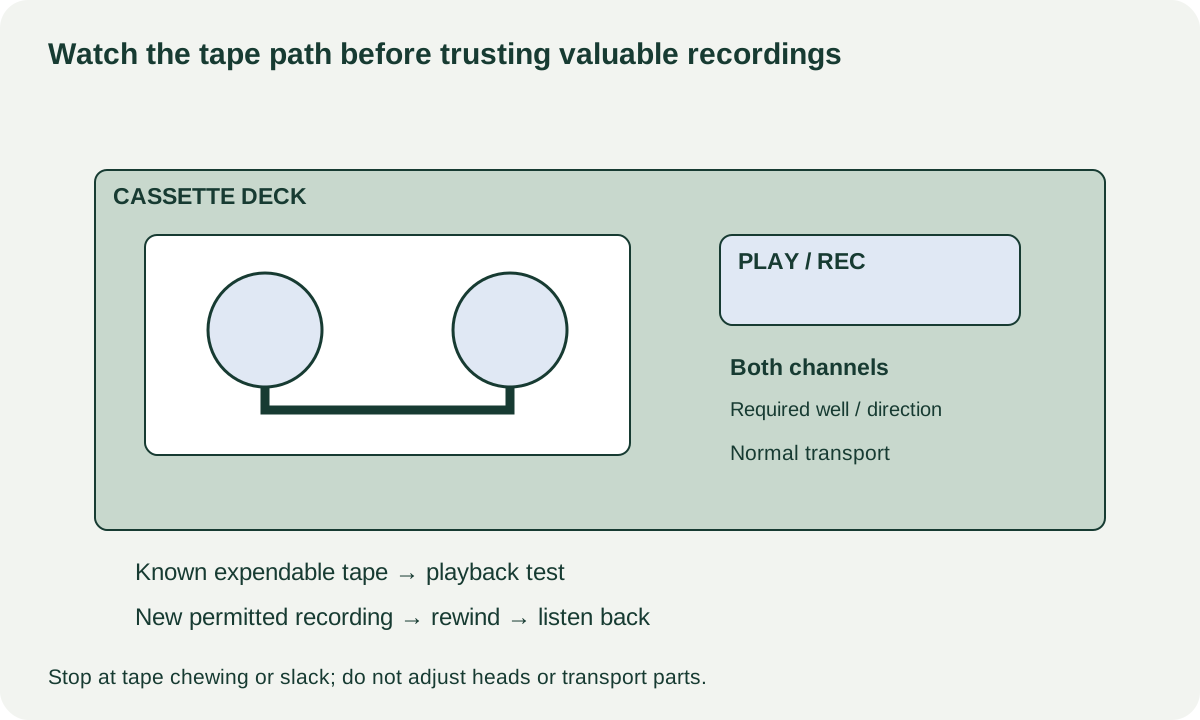
Use an expendable, known-good tape containing familiar audio you are entitled to use. Do not make an irreplaceable original the first test of an unfamiliar transport. For recording, use a separate suitable expendable tape and agree in advance that its contents may be overwritten.
Bring a known-good listening chain or arrange one with the seller. A deck may need an amplifier or powered listening system; a headphone socket, if present, is a separate path. Start at a comfortable volume. Do not use a distorted tape or faulty cable as the sole reference for the deck.
 Enlarge diagram
Inspect the accessible tape path without adjusting it
Look at the exterior, door operation, controls and accessible transport area with power handled according to the manual. Ask about corrosion, liquid exposure and long storage. Visible residue, damaged rollers or a door that will not close properly deserves attention, but avoid declaring a complete mechanical diagnosis by sight.
Do not touch the heads or tape path with fingers, turn adjustment screws or apply cleaning chemicals at pickup. A seemingly small adjustment can change performance and obscure the condition you were trying to assess. If the value depends on transport alignment or calibration, obtain a qualified service assessment.
Have the seller load the tape normally. Watch for hesitation, slack, scraping or a cassette that needs force to seat. Stop immediately if the machine begins to chew or spill tape. Do not repeatedly try the same failing transport in the hope it will settle down.
Give each advertised function a separate check
Play familiar material and listen to both channels. Try ordinary pause, stop and resume, then supported fast forward and rewind. Test the relevant direction or second well if it is part of the purchase. A turning counter and lit meters do not establish usable sound.
Listen for obvious instability, dropouts or distortion without claiming a casual hearing test measures speed accuracy or wow and flutter. If a problem appears, compare a second known tape and a known-good cable where practical. A fault repeating through the same channel or transport remains unresolved even if its cause could be the tape, electronics or mechanics.
For recording, make a short original sample using the supported input and sensible documented level. Rewind and listen to that new recording. Playback of an existing tape does not demonstrate the recording path. Do not infer noise-reduction compatibility or calibration from a switch label; match the source and tape workflow in the manual.
| Observation | Next buying step |
|---|---|
| Both channels play and transport handles tape normally | Record what was tested; consider service history separately |
| One direction or well untested | Do not price it as demonstrated working |
| Tape slack, chewing or repeated transport stall | Stop and obtain service evidence |
| Unstable pitch or intermittent sound | Ask for a diagnosis; no guessed belt-only fix |
| Recording required but not demonstrated | Arrange a recording test or choose another candidate |
Cost the machine as it stands today
A hypothetical deck is $60 and a shop quotes $140 for specifically assessed work, plus $20 collection: $220. A $200 deck with a documented recent service and a successful required-function demonstration may be the better route. These figures are examples, and a quote for one fault does not cover every unknown part in an old machine.
Ask whether the service provider can obtain the required parts before valuing a non-working deck as an easy project. An unavailable gear, motor or proprietary component changes the decision more than a clean front panel. If restoration is your intention, use the for-parts guide and set a total project budget you can accept losing.
For a ready-to-use purchase, choose normal tape handling, useful recording/playback evidence and a supportable service path. Remove tapes before transport, secure the unit as its manual directs and keep the tested accessories together. Protect your valuable tapes by establishing the machine’s condition before trusting it with them.