Used drones: aircraft condition, ownership and a permitted test
Quick answer
Treat a used drone as an aircraft, controller, battery and account-transfer purchase. Verify exact compatibility and current support, inspect accessible crash or repair evidence, and have the seller complete the supported ownership process. Arrange a demonstration only where the operator and flight comply with current rules. A successful hover does not certify the aircraft or predict battery life.
Start with the operation you are allowed and equipped to perform
Decide where and how you intend to use the drone before comparing camera specifications. The aircraft’s weight, configuration, safety features, location and type of operation can affect the rules. In the US, start with the FAA’s drone guidance for the intended operation, registration, pilot requirements, airspace and applicable Remote ID rules. In Canada, use Transport Canada’s current drone guidance to establish the applicable category, pilot requirements, registration and location restrictions. A small drone or a private sale does not make every flight permissible.
Separate regulatory suitability from hardware condition. A working aircraft may be unsuitable for your planned operation; a model eligible for a category may still be damaged or locked to an owner. Check both before paying. If you will operate elsewhere, check the responsible aviation authority and local site restrictions there rather than carrying a Canadian assumption into another jurisdiction.
For the pickup, agree that the seller or another appropriately qualified operator will conduct any permitted flight. Do not make your first flight with unfamiliar controls in a parking lot, near bystanders or under pressure to finish the sale. When a lawful demonstration cannot be arranged, record the flight functions as untested and choose whether you need another inspection opportunity.
Inventory the actual aircraft system
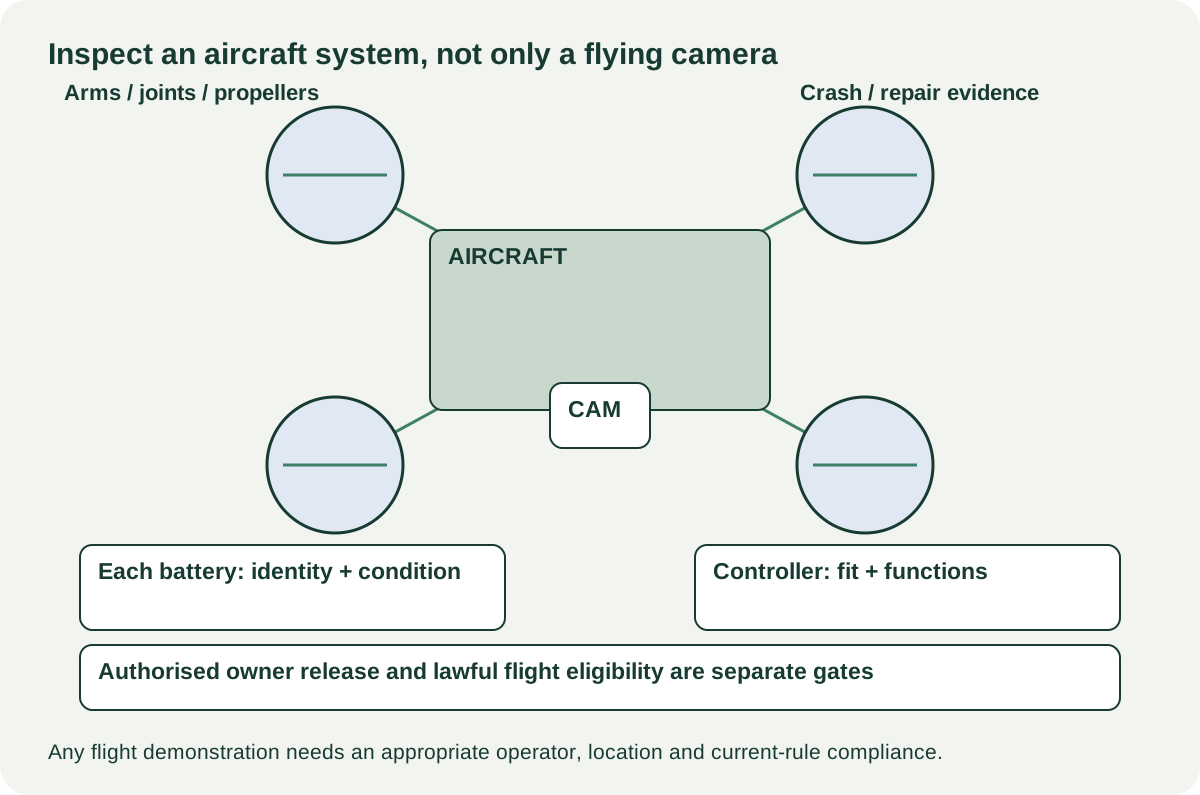
Ask for exact model labels on the aircraft, controller, batteries and charging equipment. Record all batteries individually, along with their identity, claimed age, visible condition and supported information shown in the app. A bundle of several batteries is not several equally valuable batteries.
Confirm controller, phone/tablet, app and firmware compatibility using the maker’s current support resources. Some similarly named controllers or aircraft revisions do not form the intended combination. Establish whether the mobile device you own supports the required application and whether the seller’s optional accessories are compatible with this aircraft.
| Component | Evidence to obtain |
|---|---|
| Aircraft | Exact model, disclosed crashes/repairs and current support |
| Controller | Compatible model, working controls and screen or phone connection |
| Each battery | Correct type, visible condition, history and supported status information |
| Charging | Correct charger/hub and cables; each relevant charging path |
| Camera/gimbal | Normal startup, controls and a newly recorded file |
| Ownership | Seller able to complete official account release and buyer setup |
| Operation | Lawful site and operator for any agreed flight demonstration |
 Enlarge diagram
Inspect accessible crash evidence before powering up
Look at arms, hinges, landing structure, motor mounts, propellers and camera/gimbal assembly. Ask about drops, collisions, water exposure and repairs even if the outer shell looks clean. Mismatched parts or marks are questions to resolve, not proof of a particular accident. Check any service documentation against the actual aircraft privately.
DJI’s collision guidance notes that a collision or drop can affect structure and internal components. Therefore, a short flight is not a substitute for appropriate inspection after a disclosed impact. If you see cracks, distorted assemblies, damaged propellers or uncertain repairs, stop the ordinary demonstration and seek competent service assessment.
Keep batteries and electronics closed. Inspect for swelling, leakage, damaged contacts, cracked housings or abnormal fit without forcing a pack into place. DJI’s battery-maintenance guidance is the model-family starting point for supported status and care; apply the exact aircraft’s instructions. A suspicious battery is not something to charge or fly just to determine whether it still works.
Reported cycles or charge information can support the history, but a low number is not a remaining-life guarantee. Record any warning exactly and have the seller resolve it. Do not count an unsafe or unusable battery as a valuable spare simply because it adds to the bundle quantity.
Check ground functions without creating a hazardous test
Follow the manufacturer’s startup and handling procedure with the operator in control. Do not spin propellers in an improvised indoor inspection or hold an armed aircraft by hand. Check the controller’s display, sticks, switches and normal connection, and observe whether the app reports errors.
Ask the operator to demonstrate camera view, gimbal movement and recording with supported expendable media. Record a new short clip and review it afterward for missing files, obvious focus problems, abnormal movement or connection interruption. A previous aerial video may belong to another aircraft or an earlier condition.
Confirm required charging and data-transfer paths. If you need a particular recording mode or accessory, test that exact supported combination. A general live view is not evidence that every desired video format or tracking feature works. Keep nonessential advanced features outside the pickup unless the operator can demonstrate them safely and lawfully.
Use any permitted flight as limited condition evidence
At an appropriate location and under applicable rules, the qualified operator can conduct an ordinary flight within the maker’s limits and their competence. Agree the checks beforehand: normal take-off and landing, controlled response, camera recording and any required basic function. Do not request risky manoeuvres or fly near people to test sensors.
Observe warnings, unexpected movement, loss of connection or abnormal sound. A smooth short hover is useful evidence of that event, but it cannot certify all flight modes, collision avoidance, remaining battery capacity or hidden repairs. The seller should not conceal an error by rapidly dismissing it; record it and obtain an explanation supported by the manual or service findings.
If weather, location or legal conditions prevent the test, postpone it. Do not let travel cost become a reason to accept a demonstration in unsuitable conditions. A ground-only purchase can be a deliberate risk for a knowledgeable buyer, but should not be described as flight-tested.
Agree the ownership-transfer sequence in advance
DJI’s second-hand rebinding guidance describes release by the original account holder and subsequent buyer binding of the device and controller. It also explains that an unbinding request is not itself completion of that process. Use the applicable current instructions for the exact product.
Before meeting, establish that the seller can perform the required release. Agree a practical sale and transfer sequence that protects both parties and lets you verify the supported buyer setup before the transaction is finally completed. Do not accept the seller’s login credentials or a promise that an unrelated service will bypass ownership later.
Registration with an aviation authority, account binding, warranty/service-plan rights and legal ownership are separate records. Check each relevant process; removing a device from an app is not automatically an aviation-registration transfer or a transferable service plan. If the seller cannot resolve the required records, wait or choose another aircraft.
Compare the complete usable bundle
Consider a hypothetical aircraft package at $350. One battery is unsuitable and assigned no usable value; a correct replacement costs $110, a missing charger $45 and collection $25. The total is $530, before any assessed repair or regulatory costs applicable to the buyer. A $500 complete supported package with stronger demonstration evidence may be preferable. These are illustrative inputs, not drone prices.
Known missing accessories can support negotiation once compatibility and availability are confirmed. Unresolved crash damage, flight errors or owner binding should not be entered as a guessed small repair fee. A low price cannot make those prerequisites disappear.
Record the exact aircraft, controller, battery inventory, disclosed repairs and demonstrated functions. Pack and transport batteries and equipment according to the manufacturer and the transport provider’s current rules. Your first flight after purchase should follow the full supported setup and preflight process, not rely on the seller’s last successful hover.
Sources
- 01DJI second-hand ownership rebinding
- 02DJI aircraft collision or drop damage
- 03DJI battery maintenance
- 04FAA Unmanned aircraft systems
- 05Transport Canada flying safely and legally