Buy secondhand with roommates: agree before one person pays
Quick answer
Agree the needed function, space, total budget, acceptable condition and who owns the item before contacting sellers. Name one coordinator and set a spending limit they can use without another vote. Record contributions and discuss what happens when someone moves out; this worksheet is a practical agreement, not a universal co-ownership contract.
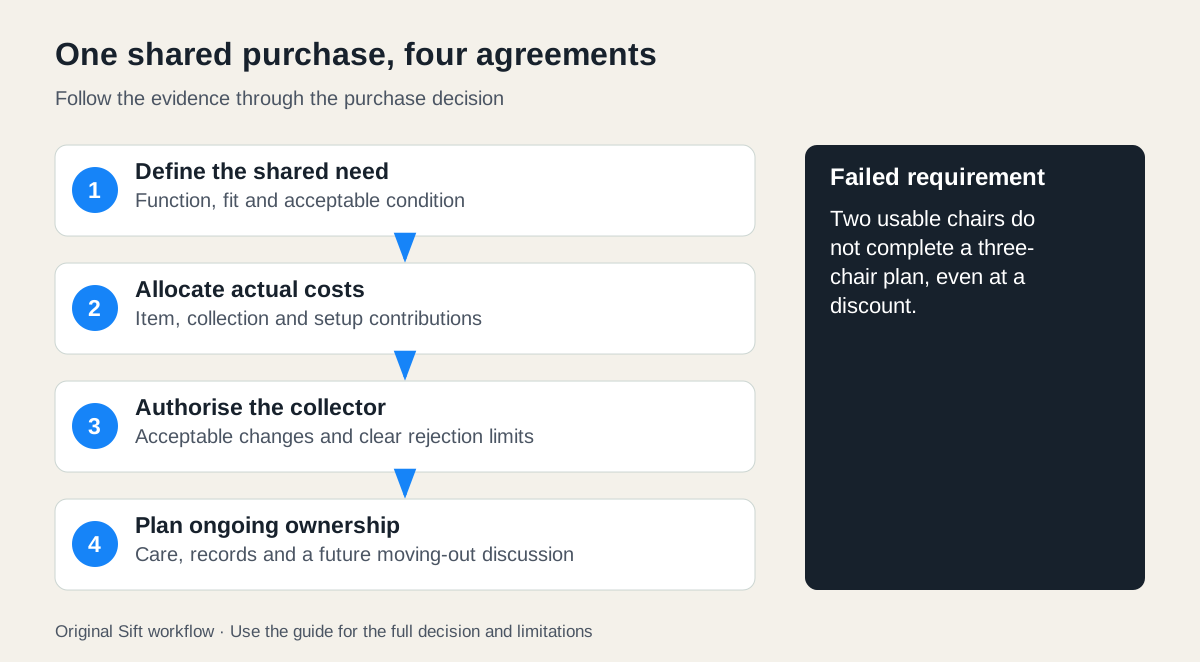 Enlarge diagram
Agree on the function before voting on a listing
A shared purchase can fail even when the item is in excellent condition. One roommate may want a dining table for everyday meals, another wants a large craft surface, and a third needs the kitchen route kept clear. Define the shared use and non-negotiable fit first.
Measure the actual room together or share a simple drawing everyone can understand. Include chairs in use, doors, storage and any accessibility requirements. Agree how cosmetic wear, upholstery, odour, cleaning and maintenance will affect acceptance. Do not make the collector negotiate those preferences while standing in the seller’s doorway.
A three-roommate dining-set plan
This is a fictional example. Three roommates need a table and three suitable chairs. They agree a $300 total limit, including collection and required setup. The table must fit their measured dining area, and a matching fourth chair is optional only if it does not increase the total or create a storage problem.
| Decision | Agreed plan |
|---|---|
| Required kit | One table, three usable chairs, all essential hardware |
| Item allowance | $210 |
| Collection allowance | $60 |
| Known setup allowance | $30 |
| Contributions | $100 each, adjusted to actual spending |
| Coordinator | One roommate sends seller messages and keeps the record |
| Inspection | Collector checks the agreed list; can reject unmet requirements |
| Price authority | Up to the agreed complete limit; no extra commitment without approval |
| Immediate fallback | Continue using the existing temporary arrangement |
A listing at $190 plus $50 collection and $20 confirmed setup totals $260. Equal contributions would be $86.67, $86.67 and $86.66, or another explicitly agreed rounding arrangement. The remaining $40 is not automatically permission to add unrelated pieces.
If one roommate pays the seller, record whether the others reimburse them and when. Paying first does not by itself settle whether the payer owns the whole item. Agree the intended ownership arrangement separately.
Decide who can say no at inspection
Give the collector clear authority to reject the item if a required chair is unstable, a dimension differs or essential hardware is missing. Also define acceptable minor differences, such as a disclosed surface scratch. The person at pickup should not feel obliged to buy because others have already transferred money.
If the collector can negotiate, state the permitted scope. For example, they may accept a lower price for a cosmetic mark everyone already considers acceptable, but they cannot accept an unresolved structural problem merely because it is discounted.
Keep the seller conversation in one place. The FTC recommends obtaining seller answers in writing. Here that also prevents three roommates from sending contradictory prices, pickup times or assumptions about what is included.
A failed chair changes the whole calculation
At the fictional inspection, one of the three required chairs has damage outside the agreed tolerance. The seller offers $30 off. The collector has no verified matching or suitable replacement and no authority to change the kit.
The correct decision is to pause or decline. The group needed three usable chairs, not two plus an uncertain repair. If they later find a confirmed suitable replacement for $25 with $20 additional collection, the apparent $30 discount no longer covers the $45 replacement cost. They can reconsider the revised complete plan together.
The bundle guide helps count useful pieces. The furniture fit checker can organise measurements, while the listing comparison keeps item, transport and missing-part amounts distinct.
Discuss moving out before anyone moves out
Choose a practical way to revisit ownership if a roommate leaves. Possibilities include one person owning the item from the start, shared ownership with an agreed later discussion, or treating contributions as shared household spending. These have different implications; do not casually label one “fair” for every household.
Discuss who may take the item, whether the remaining roommates can propose a buyout, how a value would be agreed at that time, and who handles sale or disposal if nobody wants it. An original contribution is not a guaranteed future refund. Wear, condition, moving cost and demand may all change the available options.
For example, the group can agree to discuss a buyout before listing the table, use current condition and actual comparable options as information, and require everyone’s approval before sale. That is a conversation framework, not a claim that the arrangement is legally binding or that equal resale shares are always required. Obtain appropriate local advice if the ownership stakes warrant it.
Keep care and records shared enough to be useful
Name the person who stores the receipt, manual, assembly information and contribution record. Give roommates access to the useful item information without circulating the seller’s private address or payment references. Record the actual purchase, not just the budget, using the purchase-record guide.
Agree who completes any required assembly or anchoring, who obtains approval for changes to the home and how a future fault will be handled. Cleaning and ordinary care should follow the product instructions. Shared use does not remove those requirements.
If the group cannot agree on the space, acceptable condition or contributions, defer the purchase. A listing deadline is the seller’s availability constraint; it is not a reason to create a household disagreement that lasts longer than the bargain.