Buying used from a business: establish who is responsible
Quick answer
Establish the business that is selling to you, the exact item, the complete price and who handles delivery and problems. Obtain the terms and receipt in that name. Business status, marketplace protection and manufacturer warranty are separate questions; check the consumer rules for your jurisdiction and transaction.
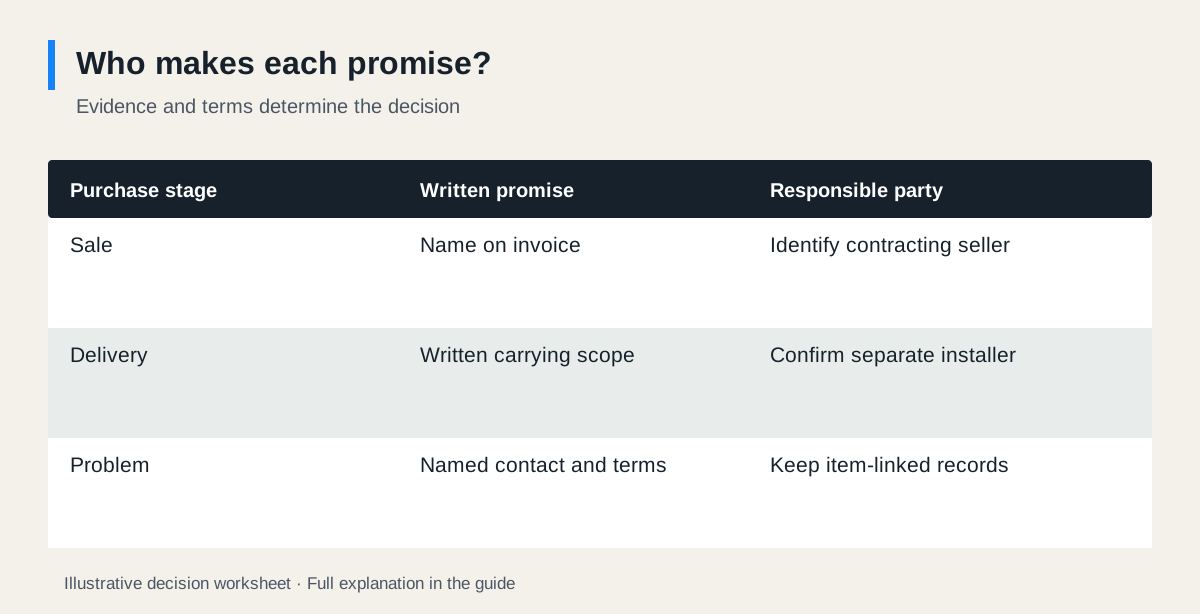 Enlarge diagram
Start with the seller’s role
A person with many listings might be a business, a collector or someone clearing a home. A storefront photograph does not resolve the question either. Ask who will be named as seller on the invoice and whether they are acting for another owner.
This matters most when several parties appear in one transaction: a household owns an appliance, a shop advertises it, another company delivers it and a service contractor offers repairs. Write down which party is making each promise. Do not assume the platform displaying the advertisement is the retailer.
A practical opening question is: “Will I be purchasing this from your business, and what seller name and contact details will appear on the receipt? Is the appliance yours to sell or are you acting on behalf of its owner?” If the answer remains unclear, do not fill the gap with the most favourable interpretation.
A three-seller appliance comparison
The following is a fictional planning comparison, not a statement about the legal status of any actual seller. The appliance itself must separately pass its model, condition and installation checks.
| Offer | What the buyer knows | What still needs a written answer |
|---|---|---|
| Household replacement sale | Individual selling their own appliance | Included parts, observed condition, agreed handover and any return promise |
| Appliance reseller | Business named on quote; service described | Exact unit, what service included, total tax/delivery price, scope of repair promise |
| Consignment shop | Shop advertises another owner’s item | Contracting seller, who takes payment, who handles a fault or refund, shop’s authority |
Suppose the reseller advertises “delivered and guaranteed.” The buyer asks whether delivered means kerbside, building entrance or installed in the kitchen. They also ask whether the guarantee covers parts, labour, collection and return travel, and who authorises the work. Until answered, those are separate unknowns rather than included benefits.
If the consignment shop says the owner makes all decisions but takes payment in the shop’s name, ask for a clear written explanation before paying. You need a usable problem contact and a record of the agreement. This guide does not decide the legal relationship from one sentence in an advertisement.
Match consumer guidance to the actual transaction
Consumer rules vary by jurisdiction, seller type, product and how the contract is made. For example, Ontario’s official return guidance explains that there is no general right to return or exchange goods, while specific legal and contractual circumstances can require a remedy. “A store sold it” is therefore not enough to assume a change-of-mind return.
In the UK, GOV.UK’s business guidance distinguishes faulty or misdescribed goods from change of mind and describes cancellation rights for qualifying distance sales. Those rules should not be copied onto an Ontario purchase or assumed to cover a private seller. Nor does finding an advertisement online alone settle how the eventual contract was concluded.
Use the relevant consumer authority when the applicable rules would change your decision. Keep any voluntary policy in writing without treating it as capable of removing mandatory rights. If the seller’s description of your rights conflicts with official guidance, resolve that conflict before committing rather than relying on an argument after delivery.
Get a usable quote
Ask for the exact model and the specific unit to appear on the quote. If the shop has several similar items, photographs and an inventory reference can prevent a substitution. Record disclosed faults in ordinary language: “scratch on left side” and “ice maker not demonstrated” are more useful than “normal wear.”
The complete quote should separate the item, applicable taxes, delivery, carrying, removal, installation and optional service. Ask which amounts are refundable if the item cannot be supplied or does not fit the agreed scope. The installation planning guide covers professional assessment; a business delivery driver is not automatically the installer.
For a hypothetical $300 appliance, $60 delivery and $90 installation, the purchase already needs $450 before any applicable tax, removal or required connection parts. Compare the real total with another supported option. Do not treat “free delivery” as decisive while installation remains unknown.
Inspect the actual item and the record together
At inspection, check that the label matches the quoted unit. Ask the seller to demonstrate the agreed ordinary functions safely. A business’s general testing process is background; the condition of the actual appliance remains relevant.
Read the receipt before leaving. It should allow you to connect the payment to this seller, this item, the disclosed condition and the agreed service or delivery terms. Correct a mismatch while both parties can see it. Save the listing and written promises privately using the purchase-record guide.
If a different model arrives, the quote changes, or the seller substitutes a verbal promise for a previously written one, pause. Recheck whether the revised transaction still works. A business address can make contact easier, but it does not make an unsuitable item suitable.
Plan the problem contact before it is needed
Record one first contact and the supporting information they will need. The FTC’s business-resolution guidance offers a practical process for explaining the problem and requested remedy. Payment-provider or marketplace processes have their own eligibility and deadlines; a seller’s review rating is not a substitute.
When comparing business and private offers, value the commitments you can actually use: a clear seller, documented work, a reachable service route and meaningful terms. Pay more only when those benefits help your situation and the complete cost remains acceptable.