How to check a Facebook Marketplace seller profile
Quick answer
Open the seller’s name or profile from the Marketplace listing, review the information and ratings available, then compare it with the item and conversation. A profile is context, not proof of ownership or a guarantee. Ask for product evidence and arrange an inspection even when the seller has an established account and strong ratings.
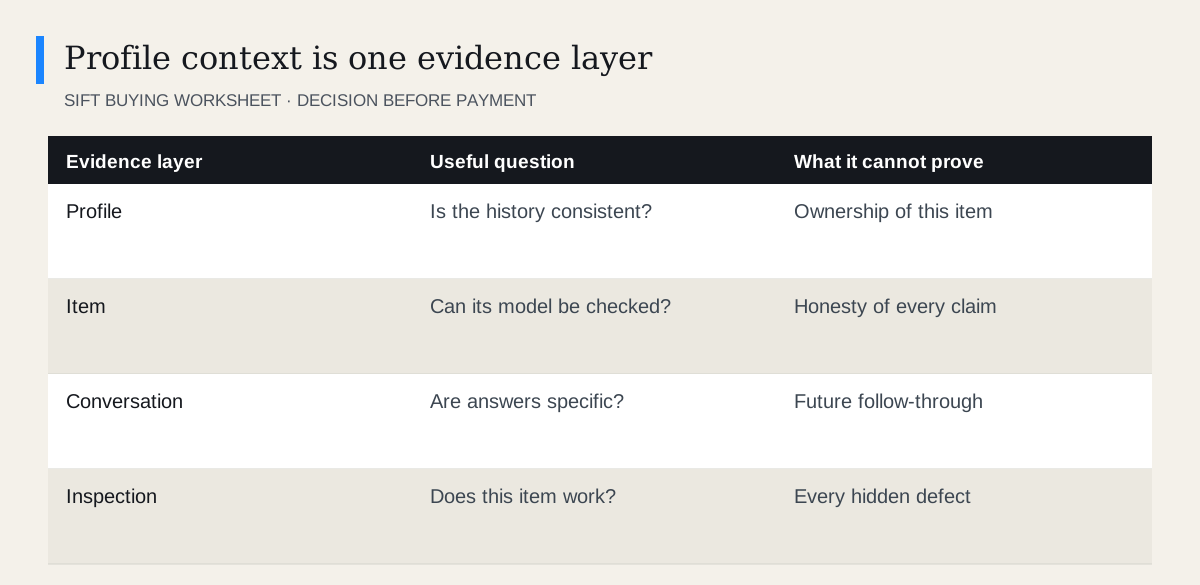 Enlarge diagram
What should you inspect on the profile?
Use the seller link inside the actual listing. That reduces the chance of looking at an unrelated person with the same display name. Review the Marketplace information shown, such as other listings and available seller ratings. Meta provides different profile views across devices, so a missing field is not itself a warning.
Read the pattern rather than searching for one decisive badge. Several household items can be consistent with a move. Many similar products can be consistent with a reseller. Neither pattern establishes that a particular item works or belongs to the person offering it.
Profile age has limits. An older account can be compromised, while an honest first-time seller can have a recent account. Avoid turning age, a photograph or a familiar-looking name into a pass/fail rule.
How much weight should ratings carry?
Meta’s ratings guidance says it does not verify whether the reviewer purchased the product or used the service. Read available comments for repeated issues relevant to your purchase, such as condition discrepancies or missed arrangements.
One negative review without context is weak evidence. Repeated, specific complaints about the same behaviour deserve more attention. Equally, a high average should not cancel out a seller asking you to pay before seeing an expensive item.
Do not contact previous reviewers or search for a seller’s private address. Your decision can rest on the listing and transaction evidence available to you.
What questions test the listing rather than the person?
Ask questions that someone with the item can answer naturally. The aim is to resolve uncertainty, not conduct an interrogation.
- Confirm the exact version. Ask for a model label or measurement. A generic product name often covers multiple generations.
- Clarify what is included. A charger in a photograph may be a demonstration accessory rather than part of the sale.
- Ask about one visible detail. A stain, different handle or missing cover can reveal whether the description matches the photographs.
- Agree a reasonable inspection. State what you need to test before travelling.
- Confirm collection conditions. Check who will meet you and whether the item is accessible at the agreed time.
A useful message is: “Could you confirm the model on the back label and whether the stand is included? If it matches, I would like to test the inputs before paying.” The message builder can help keep a request short.
How do you interpret inconsistent answers?
Separate an ordinary gap from a contradiction. Someone selling a relative’s item may not know its age. That uncertainty affects what you should pay, but it is not automatically deception.
A contradiction is more consequential: the description says complete, while the seller later says an essential adapter is missing; the listing says local pickup, while the conversation suddenly requires a remote deposit. Pause and ask for an explanation. Do not invent the reassuring explanation on the seller’s behalf.
| Observation | Response |
|---|---|
| Few reviews, detailed answers | Continue with normal inspection |
| Many listings, clear seller identity | Ask whether they sell privately or as a business |
| Stock photos only | Request current photographs |
| Different item or price in messages | Resolve before arranging pickup |
| Pressure to pay without inspection | Stop and reconsider |
When several uncertainties remain, reduce your commitment rather than increasing your investigation of the person. You can decline a purchase politely without proving misconduct. “I need an item I can test before payment, so I will pass” is sufficient.
What if the profile will not open?
Try the link again from the listing and compare another supported Facebook surface. A loading problem does not prove that the seller blocked you. If the listing is also unavailable, use the availability checks.
Keep the existing conversation. Do not create another account to work around a block or contact the seller through unrelated personal channels. If you cannot verify the item or reach a clear agreement, there are other listings.
The final decision should fit the purchase. A low-cost book and an expensive device need different inspection effort. Both benefit from the same habit: let profile information guide your questions, and let the answers and inspection guide payment.
Questions people ask
Does a five-star rating prove the seller is safe?
No. Meta says it does not verify that reviewers purchased or used the item. Ratings can inform your decision, but they cannot replace inspection.
Is a seller with no reviews a scammer?
No. An occasional seller may have few ratings. Assess the item, answers and transaction rather than treating missing reviews as a verdict.
Should I ask for government identification?
Usually that is unnecessary for an ordinary item purchase. Ask for relevant product evidence rather than collecting sensitive identity documents.