Ask for useful photos of a used item
Quick answer
Ask for photographs that answer a specific buying question: the model label, a missing angle, a defect close-up or all included parts together. Explain briefly why you need them and keep the request proportionate. Photos help decide whether to inspect; they do not prove every function works or replace an in-person check for an expensive purchase.
 Enlarge diagram
What is missing from the existing listing?
Read the description and inspect every photograph before asking for more. You may already have the answer, and a seller is more likely to respond to a focused request than a long list copied without context.
Write one sentence describing the decision: “I need to know whether this desk fits a 24-inch opening” or “I need to confirm the monitor model before checking compatibility.” That sentence tells you which photo to request.
A readable model label also lets you check the actual product in CPSC recalls in the US. Ask for evidence that answers your specific buying question, rather than another attractive overview photograph.
Which views are most useful?
- A readable label. Ask for the complete model information when identity matters.
- The hidden side. The back, underside or inside can show construction and wear absent from a front view.
- The defect in context. A close-up shows detail; a wider view shows scale and location.
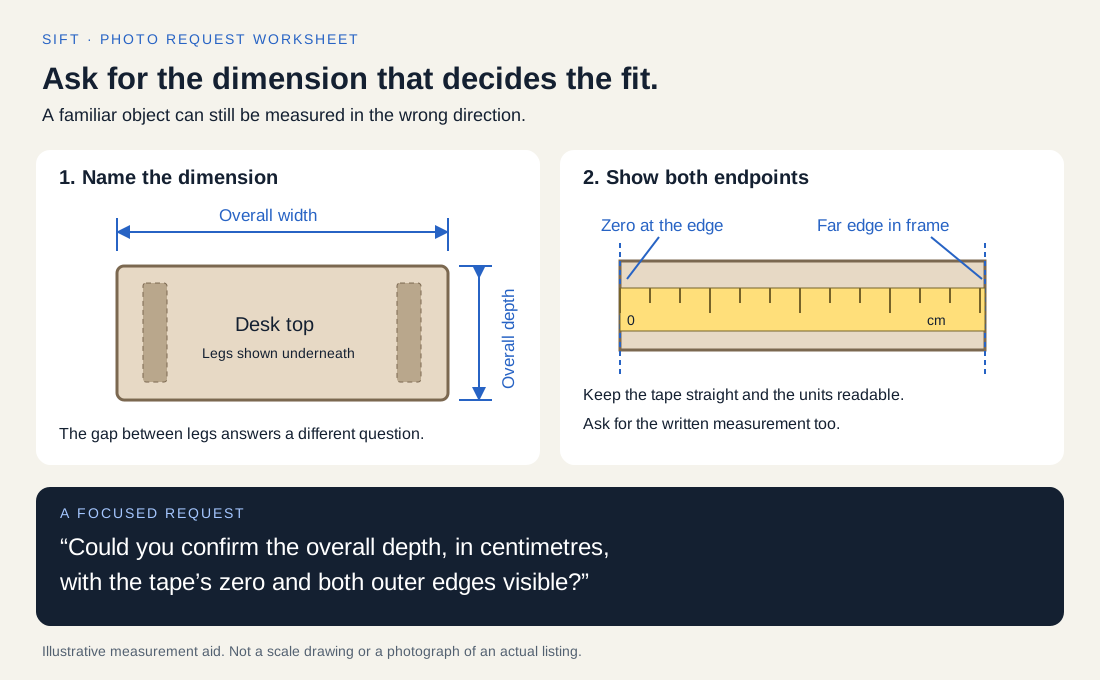
- A measured dimension. Ask for the tape’s endpoints and units to be visible.
- The included parts together. This is especially valuable for bundles and dismantled furniture.
Do not request unsafe lifting, dismantling or access to live electrical components. Ask for accessible views and arrange a proper inspection for the rest.
How should you word the message?
Keep it short and explain the reason. “Could you send a clear photo of the back label? I need to check that this model supports my connection” is specific and easy to answer.
For furniture: “Could you confirm the depth and show the underside where the legs attach? I need to check transport and the joints.” For a bundle: “Could you lay out the included cables and controllers in one photo so I can confirm the set?”
Use the message builder if you want help structuring the request. Avoid demanding a large staged photo session for a very small purchase.
What should you avoid asking for?
Do not ask for government identification, mail, account screens or a view of the seller’s home beyond what is necessary to see the item. A product question should not become a request for private information.
Avoid ritual “proof” photographs that are hard to interpret. A handwritten note beside an object might indicate current access, but it does not establish ownership, condition or the legitimacy of a payment arrangement.
| Vague | Better |
|---|---|
| Send more pictures | Could you show the rear connections? |
| Prove it works | Could you demonstrate this specific input? |
| Is it complete? | Are these named parts included, and can you show them together? |
| How bad is the damage? | Could you show the mark close-up and from a normal viewing distance? |
How do you evaluate the reply?
Check whether the new image actually answers the question. A second front photograph is not evidence of the underside. A close-up label without context should still match the product shown.
Use reverse image search when an image seems reused, but treat results as leads. Google’s Lens instructions explain how to search an image; they do not make the search an authenticity certificate.
If measurements are inconsistent, ask the seller to confirm rather than averaging them. One wrong dimension can make a collection impossible.
For a desk, distinguish overall top depth from the space between its legs. If the top must fit your room, leg spacing answers the wrong question. Ask for the tape to start at one outer edge and end at the other, with the units visible. A diagonal tape, a cropped endpoint or a tape held above the surface leaves the dimension unresolved. Confirm the measurement in the message as well as the photograph.
When are photos enough to proceed?
They are enough when they reduce uncertainty to something you can reasonably resolve at pickup. They are not enough when the purchase depends on a function that remains untested or an identity claim that remains unsupported.
Set a clear next step: “That answers the size question. I would like to inspect the condition on Saturday.” Save the relevant answers with the listing, then use the pickup checklist.
If the seller cannot provide the evidence, you can accept the uncertainty at an appropriate price, arrange a viewing or pass. You do not need to accuse anyone to decide that the available information is insufficient.
Questions people ask
How many extra photos should I request?
Ask for the smallest set that resolves your decision. One label photo and one condition detail may be enough; a complicated bundle can need more.
Does a refusal to send photos prove a scam?
No. The seller may be busy or unable to provide them. You can still decline when the remaining uncertainty is too high.
Should I ask for a video?
A short demonstration can help with a specific function, but agree what it should show and still inspect the actual item before payment where practical.
Sources
- 01CPSC Recalls
- 02Google Search with an image on Google
- 03Federal Trade Commission Buying From an Online Marketplace